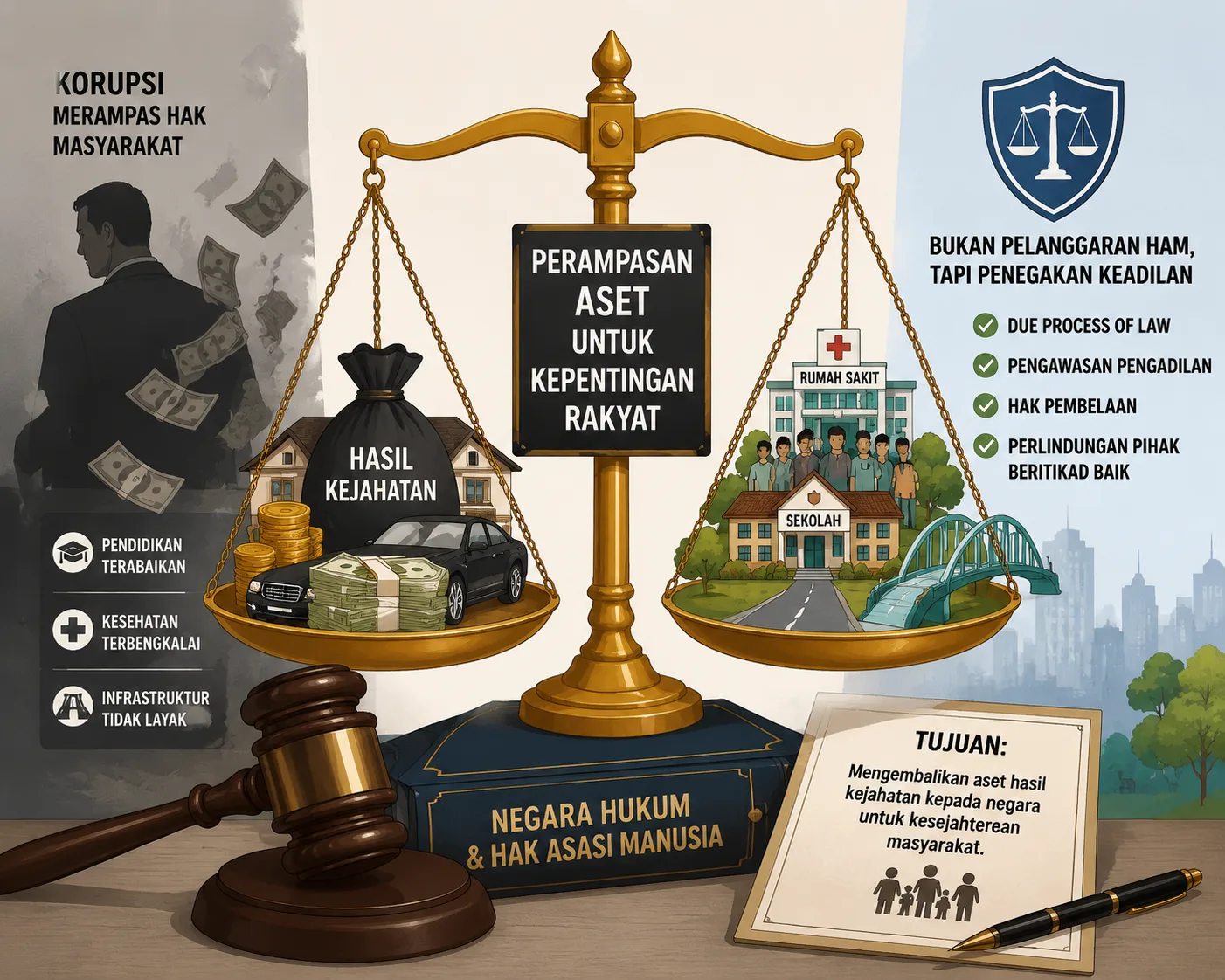
When the education budget is corrupted, children lose the opportunity to get a decent education. When health funds are misappropriated, people lose access to health services. When the infrastructure budget is misapproperated, the people have to bear the bridges, collapsed roads, unfit schoolrooms to poor public services. Therefore, corruption is actually a human rights violation (HAM) in the social and economic dimensions.
Indonesia has an Anti-Corruption Crime Act, a Prevention of Money Laundering Crime (TPPU) Act, but ironically the recovery of the country's losses is still far from optimal.Search for the site)
IPW data indicates that each year at least Rp 300 Trillion of APBN funds are leaked due to the flooding of the government procurement budget. Of that value, which can be recovered only about Rp 37 Trillion.
This is where the urgency of the Asset Robbery Bill became so important. The main philosophy of the bill is simple but fundamental: the consequences of crime should not remain in the hands of the perpetrators, but should be returned to the state for the benefit of the public. asset recovery As one of the main principles of the eradication of corruption.The Commission shall adopt delegated acts in accordance with Article 21 of this Regulation.)

Several countries have proven the effectiveness of this policy. criminal forfeiture and civil forfeiture Singapore has a very effective asset seizure mechanism through Corruption, Drug Trafficking and Other Serious Crimes (Confiscation of Benefits) Act. Switzerland actively returns corrupt assets to the home country through mechanisms asset repatriationItaly even knows. Preventive confiscation These countries are not considered human rights violators, but rather they have managed to strengthen the rule of law through strict surveillance mechanisms.
One of the most frequently raised reasons for rejecting the Asset Robbery Bill is concern over potential human rights violations, particularly property rights. These concerns should be respected as part of a healthy legislative process.
The right to property is indeed a constitutional right, but neither national law nor international human rights instruments have ever provided protection against property derived from criminal offences. Rights protection is given to legitimate property, not to the result of corruption, money laundering, drug trafficking, or other economic crimes. In other words, assets acquired through criminal offense cannot be equated with property rights acquires legally.
What needs to be protected is not the existence of the Asset Robbery Bill itself, but the legal design. due process of lawThe Bill also emphasises the importance of protection against third parties and legal certainty in the discussion of the Bill.UIN Antasari Law School)
With these guarantees, the Asset Seizure Bill is actually a legal instrument in line with the rule of law (rule of lawIt is not a right of a person to be deprived, but a profit obtained through breaking the law.
Furthermore, the human rights perspective should focus not only on the rights of perpetrators, but also on the right of millions of citizens affected by corruption.Every rupee successfully recovered can be reused to build schools, hospitals, roads, irrigation, and various public services that are the rights for the public.
The drafting of the Asset Robbery Bill should no longer be stuck in the dichotomy between the eradication of corruption and the protection of human rights.
Ultimately, the main purpose of the Asset Robbery Bill is not to arbitrarily expand the power of the state, but to ensure that crime is never a way to gain wealth. Corruptors must lose all the profits they gain illegally. Because eliminating corruption that only punishes bodies without taking the consequences of their crimes will never have the acute effect.