About Indonesia Procurement Watch
Indonesia Procurement Watch (IPW) is an independent Indonesian non-governmental organisation (NGO) and civil society organization (CSO) focused on monitoring government goods and services procurement and preventing corruption in the public procurement sector.
Who We Are
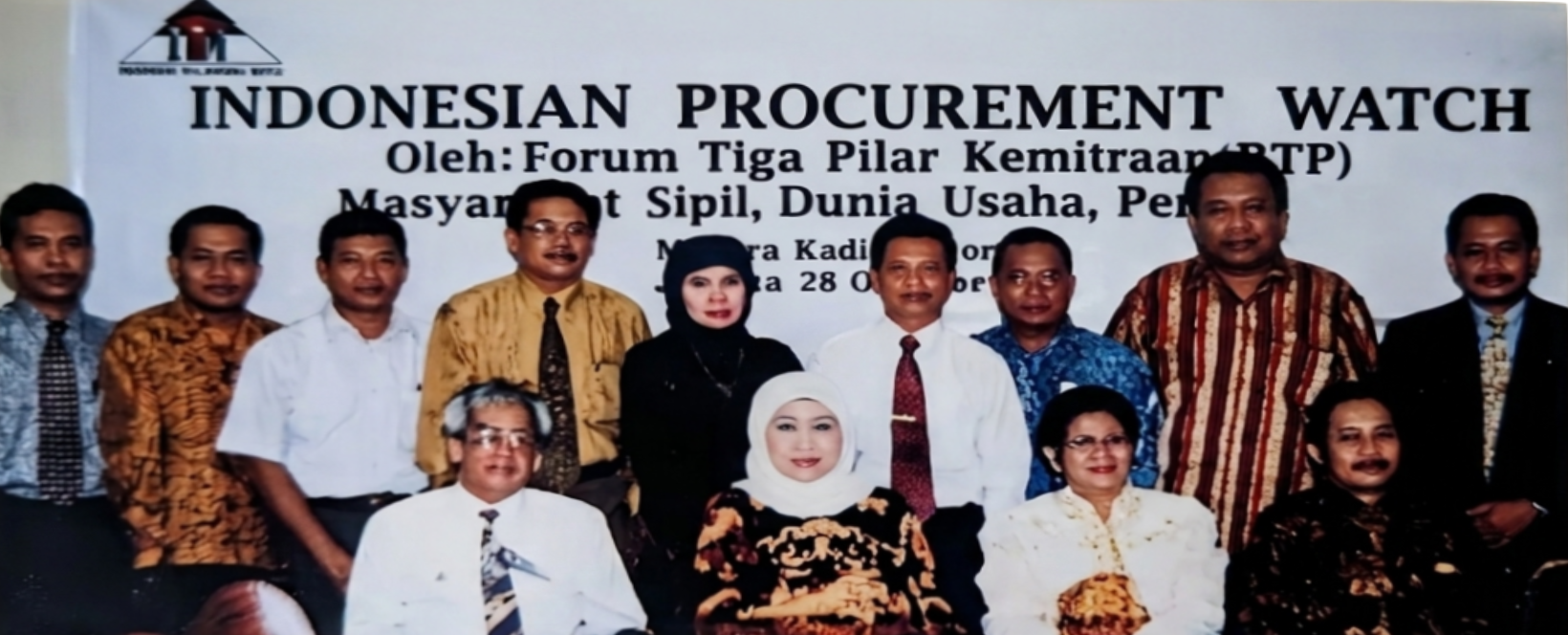
IPW was declared on 28 October 2002 by figures drawn from civil society, business, and government — a non-profit, non-partisan organisation born of concern over the many problems in Indonesia's public procurement system and practice.
IPW exists to confront a hard reality: the procurement of goods and services is the single largest source of corruption in Indonesia. As IPW has repeatedly noted, roughly 70 percent of corruption cases handled by the Corruption Eradication Commission (KPK) originate in goods and services procurement. A World Bank study has even estimated leakage of 10 to 50 percent in development budgets channelled through government procurement.
With annual procurement budgets ranging from Rp250 to Rp375 trillion sourced from the state budget (APBN), IPW argues that public oversight is essential — beginning at the planning stage, not only at execution. IPW also actively champions e-procurement to reduce direct contact between providers and officials.
Beyond monitoring and advocacy, IPW develops anti-corruption procurement toolkits that help the public recognise fraud risks, so that transparency can genuinely translate into accountability.
Vision & Mission
Vision
A public goods and services procurement system free from corruption, collusion and nepotism, built on the principles of Clean, Transparent and Professional conduct (Bersih, Transparan dan Profesional — BTP).
Mission
To eliminate corruption, collusion and nepotism throughout public goods and services procurement — by strengthening the role of the public, supporting the government in formulating and implementing policy, and advancing the professionalism and integrity of every party involved.
Through this, IPW aims to proactively and effectively drive the realisation of good and clean governance in Indonesia (Good Governance).
Our Role & Approach
In practice, IPW works through three mutually reinforcing roles — policy study, community empowerment, and monitoring — all converging on a single goal.
Policy Study & Recommendation
IPW contributes to developing the legal framework and management systems for public procurement through research, discussion forums, and seminars. The results are delivered as policy recommendations to stakeholders and published for the wider public.
Community Empowerment through Awareness & Training
Good procurement governance demands a three-pillar partnership — government, business, and civil society. IPW runs mass-media campaigns and training so communities can take an active role in overseeing procurement across the regions.
Communication Network & Monitoring
Preventive, detective, and corrective efforts against collusion and corruption in public procurement are far more effective with community monitoring. IPW equips and facilitates civil society to monitor procurement across agencies and projects in their own regions.
Programmes
These roles are delivered through the following five programme areas.
Researching
- Public procurement law
- Good procurement governance index
- Pathology analysis of public procurement
- Procurement policy & regulation studies
- E-procurement & e-auction consulting
- Regular seminars & discussion forums
Communicating
- IPW website management
- Public procurement journal & bulletin publishing
- Anti-corruption mass-media campaigns
- Procurement information centre
- Books & other reference publishing
Capacity Building
- “Three Pillars” workshops
- Training for civil society organisations
- Training for journalists
- Training for law enforcement officers
- Training for local government officials
- Training for the local business community
Monitoring
- Integrity pacts
- IPW “black listing”
- IPW reporting PO box
- IPW proactive investigation
- IPW monitoring committee
Institutional Building
- Partnership building
- CSO network development
- Infrastructure development
- Human resources development
- Comparative studies
- Business unit development
Organisational Structure
Founding Members
- Prof. Dr. Komaruddin Hidayat
- Todung Mulya Lubis, SH
- Agus Rahardjo
- Batara Lumbanraja
- Bambang Warih Koesoema
- Djoko Susilo
- Dewi Motik Pramono
- Drs. Mar’ie Muhammad, MA (alm.)
- Amir Husin Daulay
- Al Mulyadi Mamoer
- Arfan Sofan
- Budihardjo Hardjowiyono, M.Sc.
- Ir. Firmansyah Rahim, MSc
- Suryo B. Sulisto
- Drs. Warsowiwoho MBA
- Narmawan Kaeni
- Irman R. Kartawijaya
- M. Farid
- Manalu Mamora
- Drs. Muhammad Abduh
- Pacifico Floresca
- Rusman Ismail
- Hayie Muhammad
- Sakdun
- Drs. Sarwedi, M.Si.
- Subagya Sastrosugito
- Suroto Prayitno
Executive Body (Badan Pekerja)
- Executive DirectorHayie Muhammad
- Finance & AdministrationSidhalta
 Data & Investigation ManagerRonald Sihotang
- Legal & Litigation ManagerHarsono, S.H
- Research & Programme ManagerY. N. Bylmoreno
- Training ManagerFarrel Muhammad, S.H
- Communications & Inter-Agency Relations ManagerShafa de Marsha
 IT & Data ManagerLofee
Contact Us
Have information about alleged procurement irregularities, want to collaborate, or need a media statement? Send us a message.